

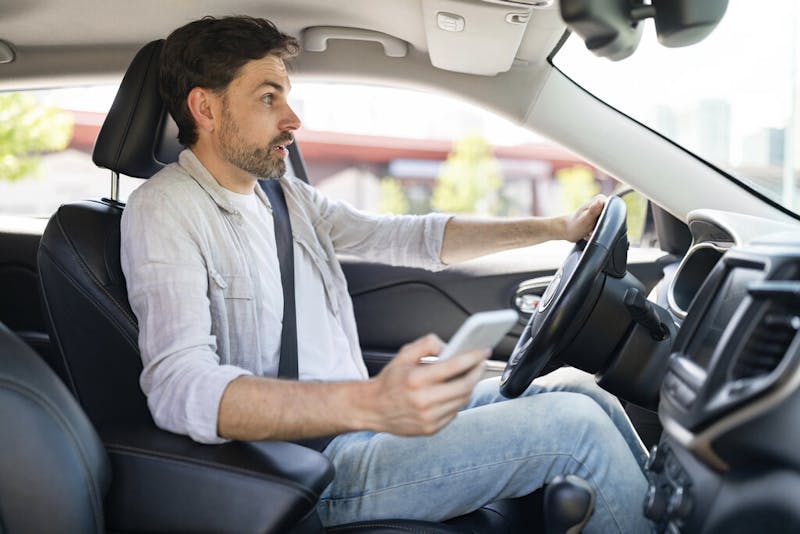
Cell phone records can show whether a driver was texting, talking, or scrolling at the exact moment of a crash, and that timing evidence often determines who is liable. Under Florida Statute 316.305, a driver's phone billing records are admissible evidence in any car accident resulting in death or personal injury.
Schwed, Adams & McGinley, P.A. brings more than 200 years of combined litigation experience to Florida car accident claims. Founding partner Stephen W. Schwed and partner Hubert S. McGinley have each tried more than 100 jury trials to verdict, and Paul M. Adams is a Florida Bar Board Certified Civil Trial Lawyer. Before joining the plaintiff's side, McGinley spent years representing insurance companies and corporations as an equity shareholder at a defense firm, and other attorneys at the firm share that same insurance-defense background. That experience gives the firm unmatched insight into how carriers try to explain away distracted driving, and how to use phone records to counter it.
This guide breaks down what cell phone records actually contain, how they are obtained, and what role they play in building a car accident claim in Florida.
What Exactly Are Cell Phone Records?
Cell phone records are the data a wireless carrier keeps about a device's activity, not the content of a text or call itself. In a car accident claim, these records include:
- Timestamps for outgoing and incoming calls and texts
- Call and text duration
- Data session start and end times, which can indicate app or browser use
- Cell tower connection logs, which help establish a device's approximate location
Carriers do not typically retain the text of text messages for long, so records used in litigation usually focus on timing rather than substance. That timing is often enough to show a driver was actively using a device seconds before a collision.
How Could Cell Phone Records Influence a Florida Car Accident Claim?
Cell phone records matter because distracted driving remains one of the leading causes of serious car accidents, and proving it strengthens a negligence claim.
According to the National Highway Traffic Safety Administration, sending or reading a text takes a driver's eyes off the road for about 5 seconds, which, at 55 mph, is like driving the length of a football field with eyes closed.
Florida operates under a modified comparative negligence system, meaning a driver's compensation can be reduced or barred based on their own share of fault. If phone records show the other driver was texting at the moment of impact, that evidence can shift a larger share of fault onto them and increase the value of a claim.
Florida's own texting-while-driving ban, found in F.S. 316.305, prohibits:
- Manually typing or entering multiple letters, numbers, or symbols into a wireless device
- Sending and reading data on such a device, for non-voice interpersonal communication, while driving
A citation or violation of this statute can serve as powerful supporting evidence of negligence in a Florida car accident claim.
How Are Cell Phone Records Obtained After a Crash?
Cell phone records are typically obtained through a subpoena issued to the wireless carrier, since carriers will not release another person's account data without a court order or the account holder's consent.
Florida law addresses this evidence directly:
- A subpoena or court order is required before a carrier will release another driver's account records
- F.S. 316.305(3)(c) allows a user's billing records, or testimony and written statements from investigating authorities, to be admitted as evidence, but only in a proceeding to determine whether a texting violation occurred in a crash resulting in death or personal injury
- Carriers retain phone data for a limited window, so timing affects whether records can be recovered at all
- An attorney typically sends a preservation letter to the other driver and their carrier soon after a crash to prevent records from being purged before they can be formally requested
Waiting too long can mean the records are gone before a subpoena is ever issued.
What Can Cell Phone Records Prove in a Car Accident Case?
Cell phone records can prove that a driver was using a device at or near the time of a collision, which helps corroborate other evidence rather than standing alone. When records show a text was sent or a call was active within seconds of the crash time listed on a police report, that overlap becomes difficult for a defense team to dispute.
Records are most persuasive when paired with:
- The official police crash report and its recorded time of impact
- Witness statements describing the other driver's behavior before the crash
- Vehicle data, such as event data recorder (black box) information, when available
What Are the Challenges in Using Cell Phone Records as Evidence?
The main challenge is that not all phone use while driving is illegal in Florida, so records alone do not always prove fault:
- Florida law permits hands-free calls, GPS use, and voice-activated texting, so a call log showing an active call does not automatically establish a violation
- The key question is usually whether the driver was manually operating the device
- Timestamp precision is another hurdle, since carrier records and police-reported crash times are not always synced to the same clock
- Attorneys often need to reconstruct the sequence of events using multiple sources to show that the phone activity truly overlapped with the moment of the crash
Steps to Take if You Believe the Other Driver Was on the Phone
If you suspect the other driver was distracted by their phone, act quickly to preserve the evidence you will need later. Here’s what we suggest:
- Request a copy of the police report and confirm it notes any phone use or citations issued
- Identify and get contact information from any witnesses who saw the other driver's behavior
- Avoid deleting anything from your own phone, since your device's activity may also become relevant
- Contact a car accident attorney promptly so a preservation letter can be sent before carrier data is purged
- Avoid discussing details of the crash on social media while your claim is active
How Schwed, Adams & McGinley Uses Cell Phone Records to Prove Distracted Driving in Florida
Cell phone records can be one of the most direct ways to prove distracted driving caused a crash, but obtaining and using them correctly takes prompt action and the right legal experience.
Several attorneys at Schwed, Adams & McGinley spent years representing insurance companies before shifting to plaintiff work, giving the firm firsthand knowledge of how carriers evaluate and dispute distracted-driving claims. For example, Paul M. Adams is a Florida Bar Board-Certified Civil Trial Lawyer, and multiple attorneys at the firm are members of the American Board of Trial Advocates. This invitation-only group recognizes elite skill and integrity in trial practice.
That combination of trial experience and insurance-side insight means the firm knows how to build a phone-record case that holds up against a carrier's defense team and move quickly before that evidence disappears. If you were injured in a Florida car accident and believe the other driver was on their phone, contact Schwed, Adams & McGinley, P.A. today at (877) 451-7977 for a free case evaluation.
Disclaimer: The information on this page is provided for general educational purposes only and does not constitute legal advice. Every case is different. Past results do not guarantee future outcomes.